Creator Hub
Designing an AI-assisted Workspace for Content Creators
Creator Hub An AI-assisted workspace that helps social media creators plan, repurpose, and optimize content across platforms, without drowning in tools.

Role
Product Design, Concept, Problem framing,Product Thinking, Business Thinking
Timeframe
3 weeks
Tools
Google Stitch, Figma, ChatGPT, Claude, Miro,Paython
Tasks Performed
0→1 Design, Ideation, Concept, Competitive Analysis, Double Dimond ,Market Gap Identification , Technical Feasibility, & interface design
At a glance
- What it is: an AI product design concept for Creator Hub, a cross-platform content workspace for social media creators.
- Disciplines: AI product design, UX design, Product & Business strategy, Product thinking.
- AI approach: LLM application design using generative AI, retrieval-augmented generation (RAG), and evaluation for output quality and safety.
- What it demonstrates: LLM and algorithm literacy, AI product thinking, business model reasoning, and interface design.
- Context: a self-directed concept from the MIT xPRO Designing and Building AI Products and Services program.
Overview
Most creators don't have a tooling problem, they have a fragmentation problem. Scheduling lives in one app, analytics in another, captions and hashtags in a third, and the creator becomes the glue between all of them. Creator Hub started from one question: what if a single workspace handled the repetitive parts of running a channel, while the creator kept full control of what actually gets published?
I took the idea through a full product pass, from framing the problem to reasoning through the AI stack and designing the core interface. I wanted this piece to show two things at once: that I can carry a concept from a fuzzy problem to a defensible pilot, and that I understand the AI underneath well enough to make real product and design decisions with it.
The Problem
From the creator's point of view:
- Repetitive manual work: reformatting one piece of content for four platforms, by hand, every time.
- Analytics overwhelm: plenty of dashboards, very little "so what do I do next."
- Inconsistent voice: tone drifts across platforms and over time.
- Tool sprawl: app-switching just to publish a single post.
The common thread: creators spend their scarcest resource, time, on their lowest-judgment tasks.
Who it's for
The pilot targets small to mid-sized creators, influencers, and freelancers publishing across Instagram, TikTok, YouTube, and Facebook. They have a growing audience but no enterprise tooling and no analyst on staff, which makes them both the most underserved group and the richest source of real workflow signal to learn from.
Research
Validating the opportunity
Before designing anything, the concept has to survive a basic startup question: is this a real gap, and would anyone actually pay to close it? What I'd check first, in an early research phase:
- A crowded market is a signal, not a warning. Buffer, Hootsuite, clip and caption tools already exist, which proves creators will pay for help here. The gap isn't "no tool," it's "too many disconnected tools." So the bet is consolidation into one AI-native workflow, not inventing a need from scratch.
- Look for spend, not stated interest. The strongest evidence of willingness to pay is what creators already do to cope: paying for schedulers, editors, or a virtual assistant and stitching them together by hand. That workaround spend is the demand, and it's what a single tool would absorb.
- Test the pain before the product. I'd run problem interviews that ask about the current workflow rather than pitch the idea, then validate demand with a simple landing page or waitlist and a concierge version run manually behind the scenes, all before writing real code.
- Name what would kill it. If creators won't connect their platform accounts, if leaving their current stack is too painful, or if the AI's output isn't trusted enough to actually save time, the concept doesn't hold. Surfacing those risks early is far cheaper than discovering them after building.
How I approached it
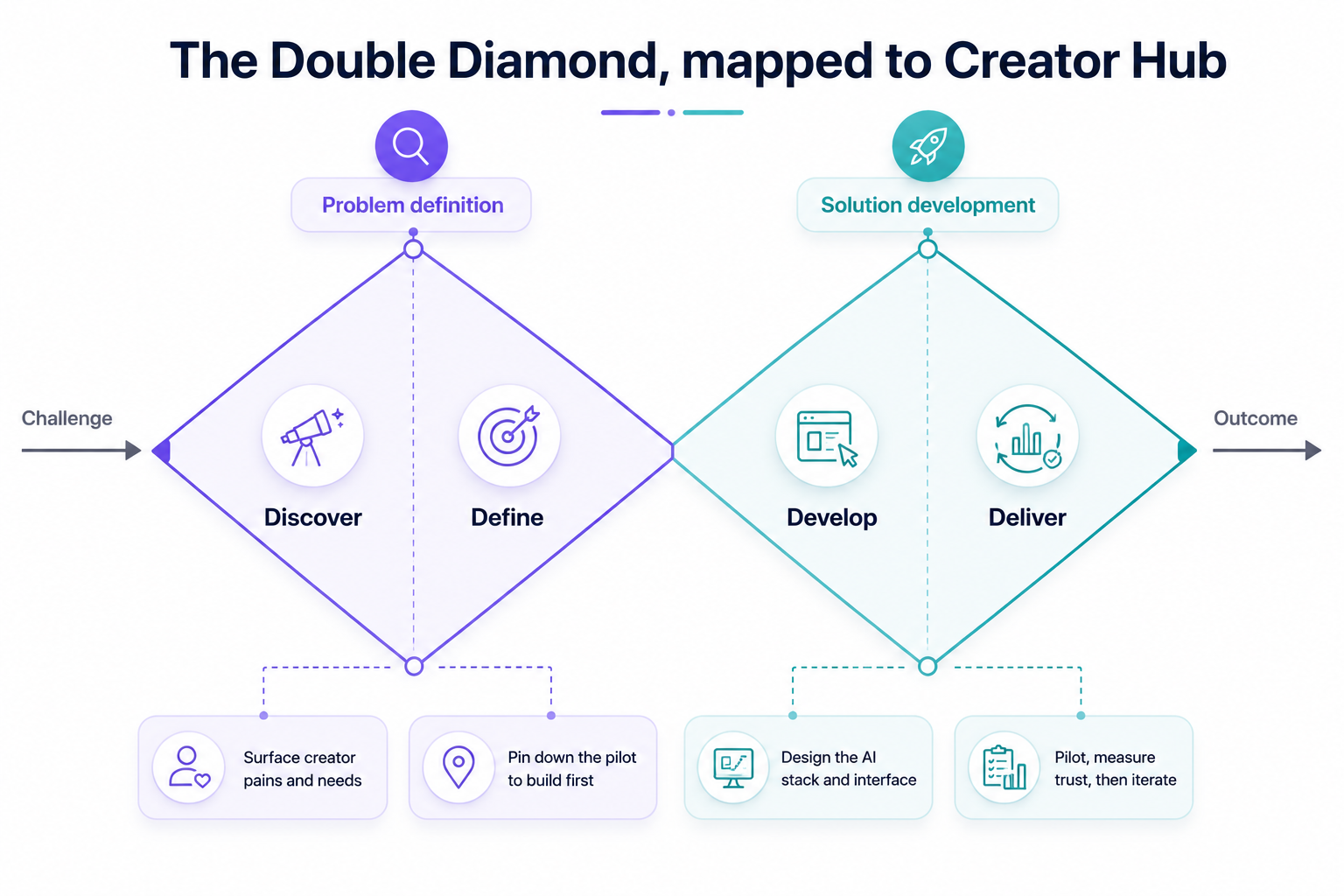
I ran the concept through two overlapping lenses: a four-stage AI design view (intelligence, business process, technology, tinkering) to pressure-test feasibility, and the double diamond to move from problem to pilot without landing in "pilot purgatory," where a prototype demos well and then never ships.
Competitive Landscape
The creator tooling market is crowded, and its own consensus is the useful part: practitioners broadly agree that no single tool does everything well, so most creators run a stack of separate apps and act as the glue between them. That fragmentation is the opening. I grouped the landscape by what each part of the stack is actually for:
| Category (examples) | Strong at | The gap it leaves |
|---|---|---|
| Scheduling suites (Buffer, Later, Hootsuite) | Cross-platform scheduling, caption assistants, basic analytics | AI is generic, not tuned to one creator's voice; analytics report data rather than a next step |
| AI repurposing (Opus Clip, CapCut) | Turning one asset into many clips and formats, fast | Single-purpose; sits outside the scheduling and analytics loop |
| Analytics tools (Metricool, Sprout Social) | Deep performance data and competitor views | Insight without action; the creator still has to decide what to do with it |
| General AI writing (ChatGPT, Jasper, Claude) | Flexible drafting and voice matching | Not connected to the creator's own accounts, data, or calendar |
Where Creator Hub fits. It doesn't try to beat any one of these at its own game. It targets the seam between them: one workspace that grounds AI in the creator's own history so suggestions match their voice, turns analytics into a recommended next action, and keeps the person approving what publishes. The competitor isn't a single feature, it's the fragmentation itself.
Strategy
Product + Business Strategy
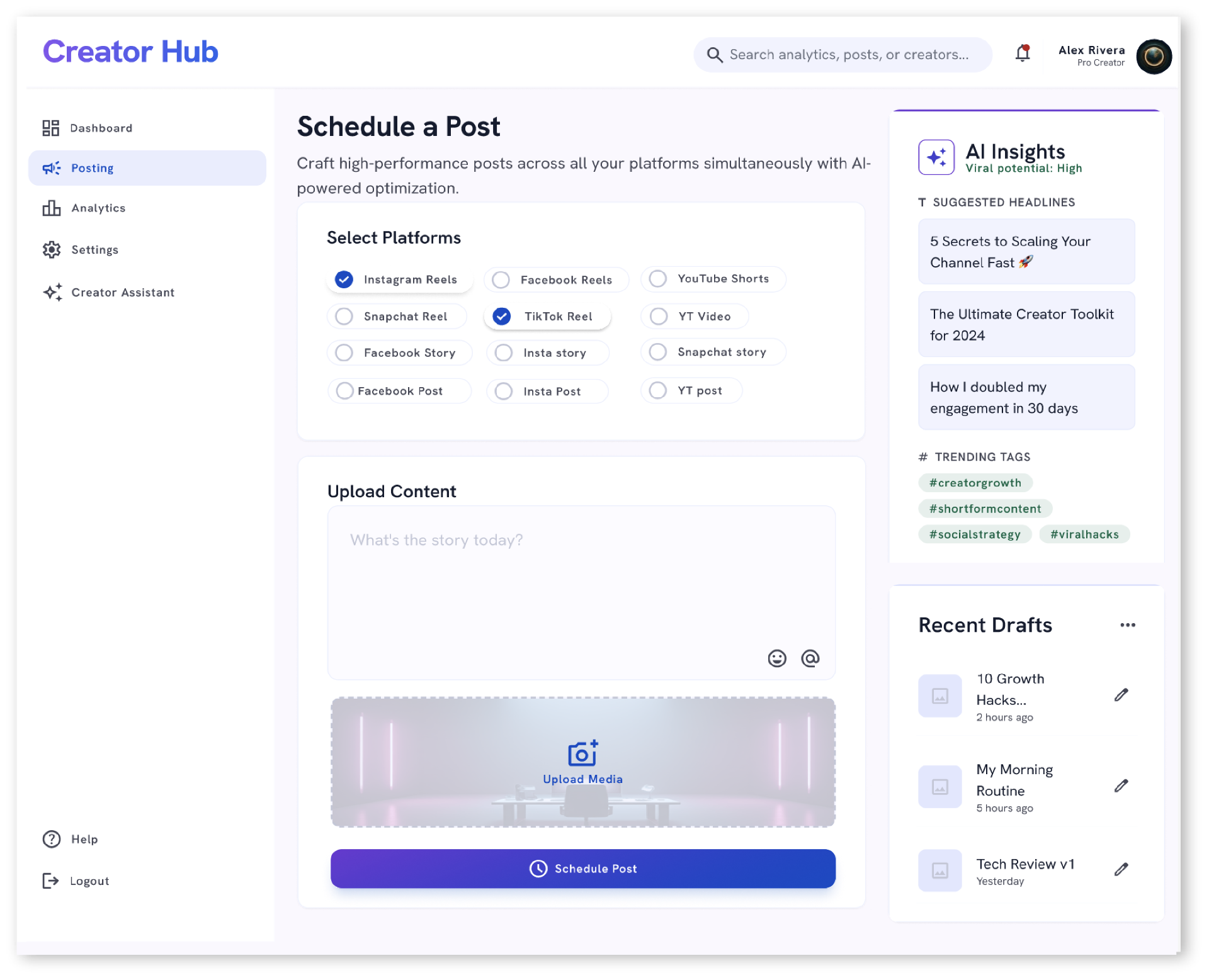
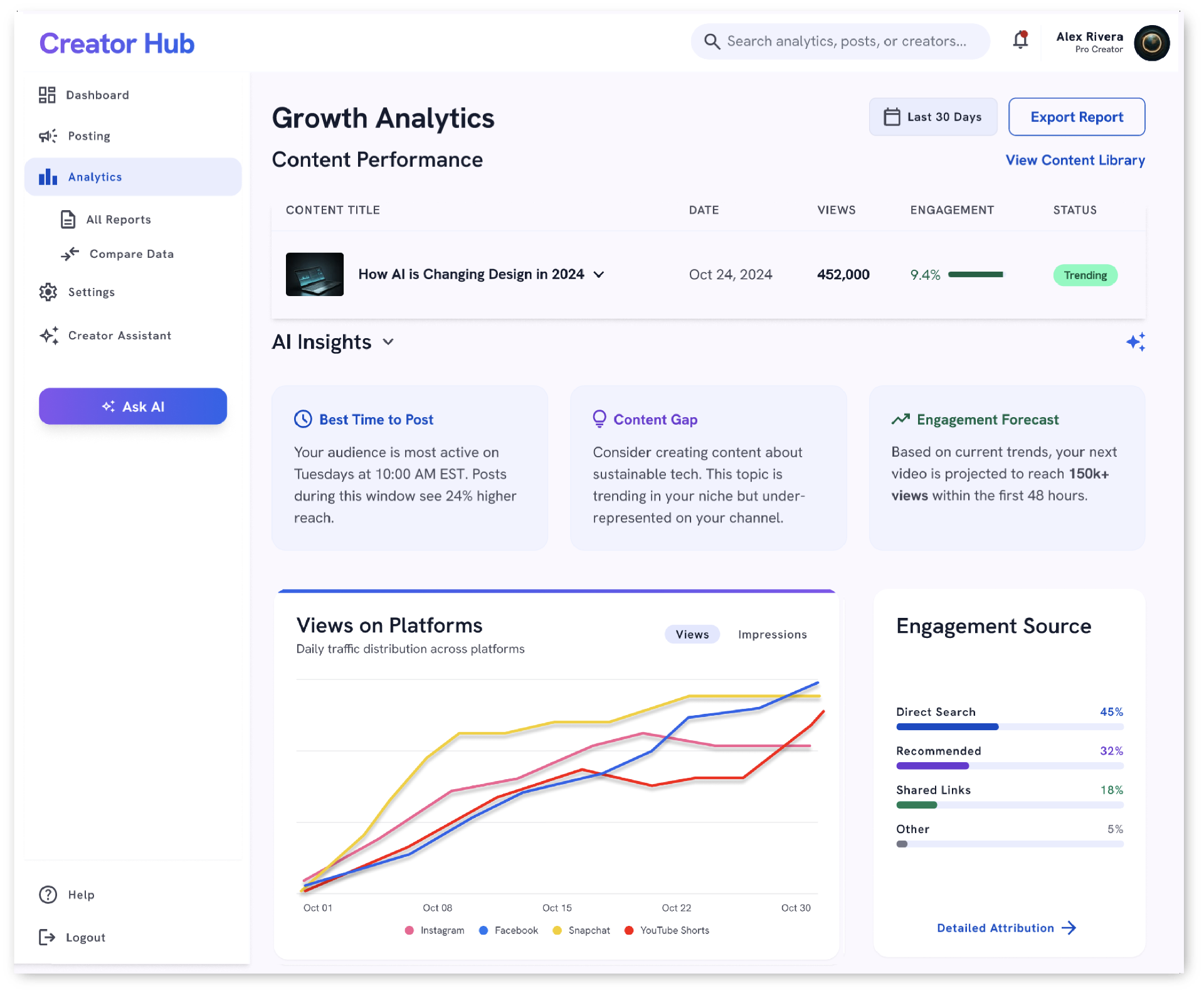
Scope, kept narrow on purpose. The pilot does a few things well rather than many things halfway: content analysis, posting optimization, cross-platform scheduling, and copy and SEO assistance. Higher-risk bets (fully autonomous content generation, video synthesis, real-time audience prediction) sit outside the first release to keep build cost and risk low.
Where the durable advantage comes from. The advantage isn't any single feature, it's the compounding loop. More creators produce more usage signal (styles, prompts, what performs), which sharpens the suggestions, which attracts more creators. Early on that loop is the growth engine. Later, tuned creator voice, saved workflows, and connected content history become real switching costs, so retention comes from accumulated value rather than lock-in for its own sake.
Designing the AI: model choice, RAG, and evaluation
This is the part I most wanted to get right, because a designer who can reason about the model makes better product decisions.
Buy before you build. I'd start with generative AI through API-based foundation models rather than train anything custom. Modern large language models (LLMs) already handle the core jobs here well: generation, summarization, classification, ranking. Building from scratch would spend time and money reinventing a solved problem. The rule I'd apply: only invest in a custom model when you have proprietary data and a differentiation need that off-the-shelf can't meet, for example a creator-voice model once there's enough per-creator history to justify it.
Grounding the outputs. Generic suggestions are the failure mode for a tool like this. A retrieval-augmented generation (RAG) layer over each creator's own history and performance data lets the system anchor recommendations in that specific account. That does two things at once: it makes suggestions personal instead of boilerplate, and it lowers the chance of hallucinated or off-brand output, because the model reasons from real, relevant context instead of guessing.
Evaluation, because you can't ship AI on vibes. I'd measure three layers: output quality (is a suggestion grounded, relevant, complete), safety (hallucination, resistance to prompt injection and unsafe content), and performance (response latency, since for a creator tool fast output is a UX feature, not a nice-to-have).
Designing against the failure modes. Two I'd plan for first. Poor generalization: the model handles common formats like a YouTube script or an Instagram caption and quietly falls apart for niche creators. Mitigation is diverse evaluation sets, a template-plus-customization layer instead of one-size-fits-all, and a lightweight "improve this output" loop that keeps the system learning from corrections. And hallucination or off-brand output, the single biggest trust breaker, handled with retrieval grounding, human review for sensitive categories, and monitoring for drift rather than a one-time check.
The principle under all of it: the creator stays in control. The AI drafts, suggests, and automates the repetitive work. The human always approves what publishes.
Design
Reflection
Approach to the pilot
I'd sequence by opportunity against risk: start with the high-value, lower-risk features that run on existing model APIs, learn from a small group of real creators, then scale personalization and analytics depth only if trust holds. If the signals point the other way, the right move is to simplify the workflow and dial automation back, not push harder.
What this shows
Designing this clarified how much of AI product work is judgment about where the model should stop. The interesting decisions weren't about what the system could generate, but about what it should hand back to the creator to approve, and how to make that handoff feel fast instead of like extra work. The other half was knowing where to lean in: using AI to fill the gaps where creators get stuck, turning the data the platforms already collect into a clear next step.